










Have you ever noticed an LED light flickering, becoming dim over time, or suddenly stopping even though the LED itself appears undamaged?
In many cases, the problem isn’t the LED chip—it’s the LED driver.
While most people compare LED lights based on wattage, brightness, or colour temperature, the driver is one of the most important components inside a lighting fixture. It supplies the correct amount of power to the LED, helping it operate safely, efficiently, and consistently.
Whether you’re selecting lighting for a home, office, retail store, or commercial project, understanding the role of an LED driver can help you choose products that offer better performance and a longer service life.
In this guide, we’ll explain what an LED driver is, how it works, and what to consider when choosing one for your LED lighting.
What is an LED Driver?
An LED driver is an electronic component that regulates the power supplied to an LED light.
Unlike traditional light bulbs, LEDs cannot be connected directly to the main power supply. They require a controlled amount of voltage and current to operate safely.
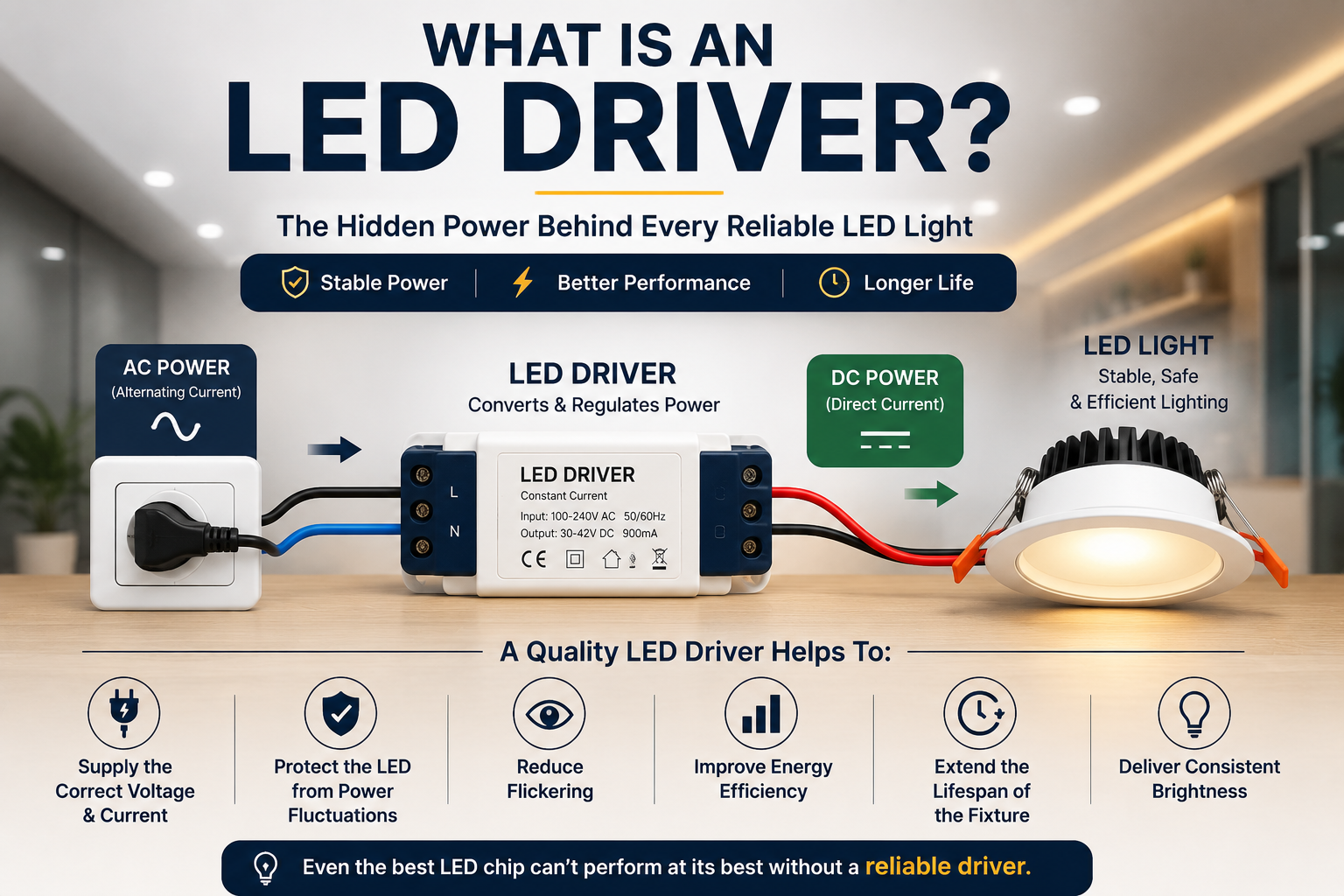
The LED driver acts as a bridge between the electrical supply and the LED, ensuring that the light receives stable power throughout its operation.
Without a driver, an LED light may flicker, overheat, or fail much sooner than expected.
Why Do LED Lights Need an LED Driver?
Every LED light depends on an LED driver for proper operation. Unlike traditional lighting, LEDs cannot be connected directly to the electrical supply because they require a controlled amount of power to operate safely and efficiently.
The electricity supplied to homes and commercial buildings is Alternating Current (AC), whereas LEDs operate using Direct Current (DC). An LED driver converts AC power into the regulated DC power required by the LED while also controlling the voltage and current.
A quality LED driver helps to:
- Supply the correct voltage and current
- Convert AC power into the DC power required by LEDs
- Protect the LED from power fluctuations
- Reduce flickering
- Improve energy efficiency
- Extend the lifespan of the lighting fixture
- Deliver consistent brightness
Without an LED driver, the LEDs would not receive the correct power, which could lead to flickering, overheating, inconsistent performance, or even permanent damage.
Want to understand this in more detail? Read our guide on AC vs DC LED Drivers Explained to learn why LEDs operate on DC power, how LED drivers convert electricity, and why this conversion is essential for reliable LED performance.
Types of LED Drivers
Constant Current vs Constant Voltage LED Drivers
Not all LED drivers work in the same way. Broadly, they are divided into two main types: Constant Current drivers and Constant Voltage drivers. The right choice depends on the type of LED lighting being used.
1. Constant Current LED Drivers
A Constant Current (CC) driver supplies a fixed amount of current while adjusting the voltage as needed. This helps protect LEDs from receiving too much current, which could reduce their lifespan or affect performance.
These drivers are commonly used in lighting fixtures where the LEDs are designed to operate at a specific current.
Common applications include:
- COB Lights
- Downlights
- Track Lights
- Spotlights
- Hanging Linear Lights
- Commercial LED Fixtures
For example, many LED COB lights use constant current drivers to deliver stable performance and consistent brightness over time.
2. Constant Voltage LED Drivers
A Constant Voltage (CV) driver supplies a fixed voltage, usually 12V or 24V, while allowing the connected LED products to draw the current they require.
These drivers are typically used where multiple LED modules or flexible lighting systems are connected together.
Common applications include:
- LED Strip Lights
- LED Profiles
- Cove Lighting
- Decorative Lighting
- Signage
- Under-Cabinet Lighting
Constant voltage drivers are popular because they make it easier to extend or customise lighting installations.
Constant Current vs Constant Voltage
| Feature | Constant Current | Constant Voltage |
|---|---|---|
| Provides | Fixed Current | Fixed Voltage |
| Common Voltage | Varies automatically | Usually 12V or 24V |
| Common Applications | COB Lights, Downlights, Track Lights | LED Strip Lights, Profiles, Cove Lighting |
| Best For | Individual LED fixtures | Flexible lighting systems |
| Widely Used In | Commercial and architectural lighting | Residential and decorative lighting |
Why Driver Quality Matters
Two LED lights may look almost identical from the outside, but their performance can vary significantly depending on the quality of the driver inside.
A good LED driver helps provide:
- Stable light output
- Reduced flickering
- Better energy efficiency
- Longer operational life
- Reliable day-to-day performance
On the other hand, a poor-quality driver may result in:
- Frequent flickering
- Inconsistent brightness
- Unexpected failures
- Reduced lifespan
- Higher maintenance costs
For commercial projects where lights operate for several hours every day, choosing fixtures with quality drivers can make a noticeable difference over time.
How to Choose the Right LED Driver
Choosing the right driver isn’t just about compatibility—it’s also about ensuring reliable performance over the long term.
Here are a few important factors to consider:
| Factor | Why It Matters |
|---|---|
| Compatibility | The driver should match the electrical requirements of the LED fixture. |
| Wattage | Choose a driver that supports the fixture’s power rating. |
| Build Quality | Better-quality drivers generally provide more stable performance. |
| Installation Environment | Outdoor fixtures may require drivers suitable for moisture and dust protection. |
| Warranty | A good warranty often reflects confidence in product quality. |
If you’re purchasing complete LED fixtures, it’s worth checking which driver is used, especially for commercial or long-hour applications.
LED Driver vs LED Chip
Many people confuse the LED driver with the LED chip, but they perform completely different functions.
| LED Driver | LED Chip |
|---|---|
| Regulates electrical power | Produces light |
| Electronic component | Light-emitting component |
| Controls voltage and current | Converts electrical energy into visible light |
| Usually hidden inside the fixture | Visible as the light source |
Both components are equally important for the overall performance of an LED light.
Frequently Asked Questions
-
What is the difference between an LED driver and an LED transformer?
Although both supply power to lighting systems, they are not the same. An LED driver regulates the current or voltage required by LEDs, while a transformer mainly converts voltage and is commonly used in older lighting systems. Modern LED fixtures generally require a dedicated LED driver.
-
Do all LED lights use AC or DC?
LEDs themselves operate on Direct Current (DC). Since homes and commercial buildings receive Alternating Current (AC), an LED driver converts AC into DC before supplying power to the LEDs.
-
Can I use any LED driver with my LED light?
No. The replacement driver must match the electrical requirements of the LED fixture, including its voltage, current, and wattage. Using an incompatible driver may reduce performance or damage the light.
-
Why is my LED light flickering even after replacing the bulb?
If the LED chip is working but the light continues to flicker, the problem may be a faulty LED driver, loose electrical connections, incompatible dimmers, or an unstable power supply.
-
How do I know if my LED driver is faulty?
Some common signs include:
• Frequent flickering
• Light turning on and off randomly
• Reduced brightness
• Buzzing sounds
• Complete failure despite the LED module appearing undamaged
-
Can an LED driver be repaired?
Some drivers can be repaired by qualified technicians, but in most cases, replacing the driver is safer, more reliable, and more cost-effective.
-
Is it cheaper to replace the LED driver or the entire light?
If the LED module is still functioning correctly, replacing only the driver is often more economical than replacing the complete fixture.
-
Can voltage fluctuations damage an LED driver?
Yes. Frequent voltage fluctuations can reduce the lifespan of an LED driver and may eventually lead to premature failure. Using quality drivers and appropriate electrical protection can help minimise this risk.