











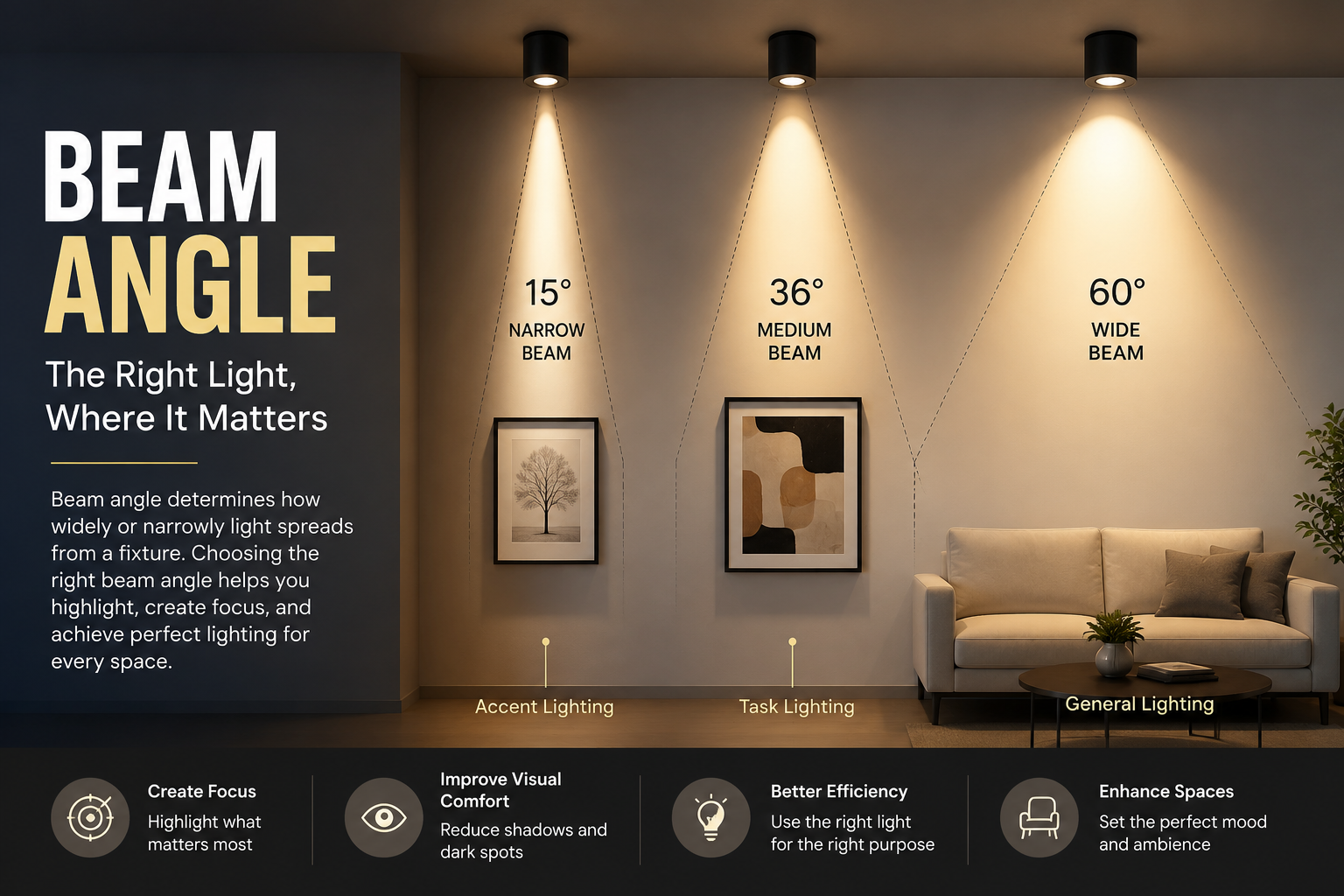
Beam angle determines how light is distributed from a fixture. It can influence everything from highlighting a piece of artwork to providing even lighting across an entire room. Even two lights with the same wattage and colour temperature can produce completely different results if their beam angles are different.
Whether you’re planning a home, office, retail store, or commercial project, understanding beam angle helps you choose lighting that not only looks better but also performs more effectively.
When buying an LED light, most people focus on specifications like wattage, colour temperature, and brightness. Beam angle, however, is often overlooked—not because it isn’t important, but because many people aren’t familiar with what it actually means or how it affects lighting.
That’s why, in this guide, we’ll explain what beam angle is, how it works, and how to choose the right beam angle for different applications.
What is Beam Angle?
Beam angle is the angle at which light is distributed from an LED fixture.
Simply put, it tells you how wide or narrow the light spreads after leaving the fixture.
A narrow beam focuses light on a smaller area, while a wide beam spreads light over a larger surface.
Think of it like watering a garden.
- A focused nozzle sprays water in one concentrated stream.
- A wider nozzle covers a larger area with less intensity.
Lighting works in a similar way.
The narrower the beam, the more concentrated the light becomes. The wider the beam, the more evenly the light is distributed.
How Beam Angle Works
Imagine shining a flashlight on a wall.
If the light stays concentrated in one small circle, it has a narrow beam angle.
If the light spreads across most of the wall, it has a wide beam angle.
The beam angle controls:
- How much area one light fixture covers
- The brightness within that area
- The mood of the space
- Where attention is directed
This is why two lights with the same wattage and lumens can produce completely different results if they have different beam angles.
Different Beam Angles Explained
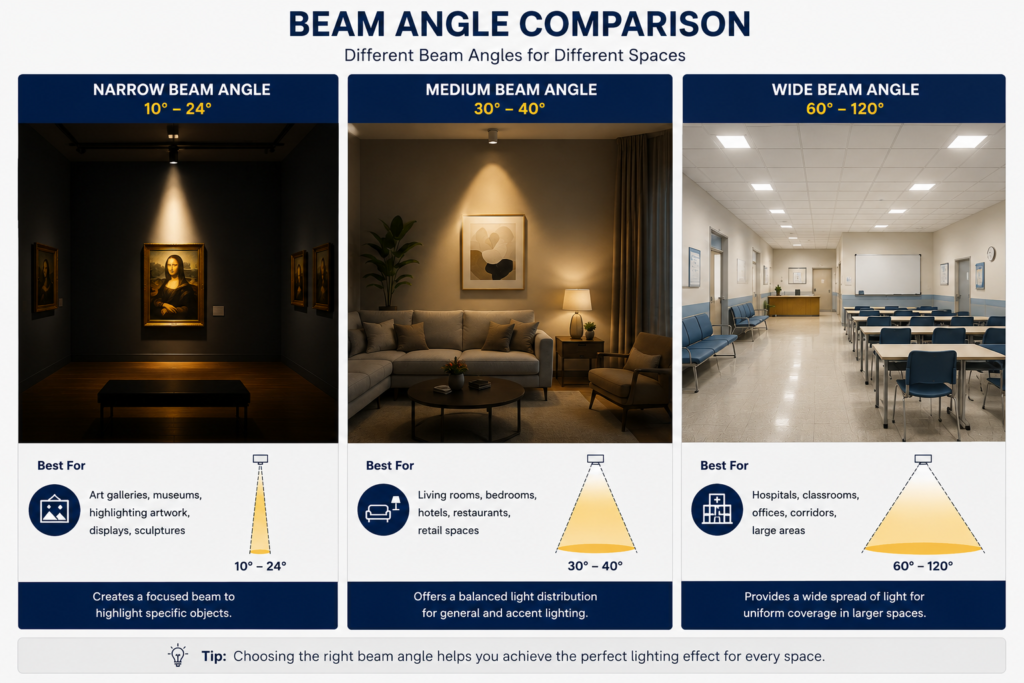
1. Narrow Beam (10°–24°)
A narrow beam creates a concentrated pool of light.
It is mainly used for accent lighting where you want to draw attention to a specific object.
Best suited for –
| Application | Why It Works |
|---|---|
| Artwork | Highlights paintings and sculptures |
| Decorative walls | Creates dramatic lighting effects |
| Display shelves | Focuses attention on products |
| Jewellery stores | Makes products sparkle |
| Museums | Highlights exhibits without lighting the entire room |
2. Medium Beam (30°–40°)
A medium beam offers a balance between focused lighting and wider coverage.
It is one of the most commonly used beam angles for residential and commercial spaces.
Best suited for –
| Application | Why It Works |
|---|---|
| Living rooms | Balanced light distribution |
| Bedrooms | Comfortable everyday lighting |
| Offices | Good coverage without excessive spread |
| Reception areas | Even lighting with subtle focus |
| Cafés | Creates a welcoming atmosphere |
A 36° beam angle is one of the most popular choices because it works well in many interior applications.
3. Wide Beam (60°–120°)
Wide beam lighting spreads light over a much larger area.
Instead of creating dramatic highlights, it provides uniform lighting throughout the room.
Best suited for –
| Application | Why It Works |
|---|---|
| Offices | Reduces dark areas |
| Classrooms | Uniform lighting |
| Hospitals | Comfortable visibility |
| Large living rooms | Better overall coverage |
| Warehouses | Covers large floor areas efficiently |
Beam Angle Comparison Table
| Beam Angle | Light Spread | Brightness | Best For |
|---|---|---|---|
| 10°–24° | Very Narrow | Very High | Accent lighting, artwork, displays |
| 30°–40° | Medium | Balanced | Homes, offices, retail |
| 60°–120° | Wide | Even Distribution | General lighting, commercial spaces |
Where can I buy outdoor lights with a 120-degree beam angle nearby?
With us, you can explore a wide range of lights with broad beam angles that can be either surface mounted or recessed into the ceiling
Beam Angle vs Brightness: Are They the Same?
No. This is one of the biggest misconceptions in lighting.
A narrow beam doesn’t produce more light—it simply concentrates the same amount of light into a smaller area, making it appear brighter.
A wide beam spreads that light across a larger surface, creating more even coverage.
Beam Angle and Colour Temperature Work Together
Beam angle controls where the light goes. Colour temperature controls how the light feels.
For example:
- A 3000K warm white light with a 24° beam creates a cozy spotlight over a dining table.
- The same 3000K light with a 60° beam provides softer, more even lighting across the room.
If you’re unsure which colour temperature to pair with your lighting design, read our guide on How to Choose the Right Colour Temperature for Every Room, where we explain when to use Warm White, Natural White, and Cool White for different spaces.
What is the ideal beam angle for home?
Many people are misguided about the kind of lighting to be placed on the ceiling; they either tend to move towards recessed cob lights or panel lights, but the best rule of thumb is to use a combination of both
For example, when we look for kitchen lights, the best is panels, as panel lights give a beam angle of 120 degrees, which makes the light spread evenly
When choosing lights for a living room, COB lights are a great option. They give the ceiling a clean and modern look with minimal visible borders.
Most COB lights come with a standard 36° beam angle, but with our COB lights, you can get beam angles up to 55°. This provides a wider spread of light, allowing you to cover a larger area without needing to install too many COBs.
Common Mistakes When Choosing Beam Angle
1. Choosing the narrowest beam for every room
Narrow beams are excellent for highlighting features but can create unwanted shadows if used as the main source of lighting.
2. Using wide beams for accent lighting
A wide beam spreads light everywhere, reducing the dramatic effect that accent lighting is meant to create.
3. Ignoring ceiling height
Higher ceilings generally require careful beam angle selection to achieve the desired coverage. A beam that works well in a room with a low ceiling may not perform the same way in a space with a much higher ceiling.
4. Looking only at wattage
Many buyers still choose lights based only on wattage. However, factors like beam angle, lumens, and LED driver quality all influence how a light performs in real-world applications.
Frequently Asked Questions (FAQs)
-
What is the best beam angle for a living room?
A beam angle between 36° and 60° generally provides balanced lighting for most living rooms, depending on the ceiling height and layout.
-
Which beam angle is best for artwork?
A narrow beam of 10° to 24° is ideal for highlighting paintings, sculptures, or decorative features.
-
Does a wider beam angle mean brighter light?
No. A wider beam spreads the same amount of light over a larger area, making it appear less intense than a narrow beam.
-
Is 36° a good beam angle?
Yes. A 36° beam angle is one of the most versatile options because it offers a good balance between focused and general lighting.
-
Does beam angle affect electricity consumption?
No. Beam angle changes the way light is distributed, but it does not directly affect power consumption. Electricity usage depends on the fixture’s wattage and efficiency.
-
How do I know which beam angle to choose?
Consider three key factors:
- The purpose of the lighting (general, task, or accent)
- The size of the space
- The mounting height of the fixture
Choosing the right combination of beam angle, brightness, and colour temperature will usually deliver the best results.
Conclusion
Beam angle may not be the first specification people notice when buying LED lights, but it has a significant impact on how a space looks and functions.
A narrow beam can draw attention to artwork or architectural details, while a wider beam creates comfortable, even lighting for everyday use. The best choice depends on the purpose of the space, the ceiling height, and the effect you want to achieve.
Rather than focusing only on wattage, it’s worth considering beam angle alongside factors like lumens, colour temperature, CRI, and LED driver quality. Together, these elements help create lighting that is both practical and visually appealing.
Taking a few extra minutes to choose the right beam angle can make a noticeable difference in the overall look and feel of your project.