










Imagine buying a beautiful navy-blue sofa for your living room. At the furniture store, it looked rich and elegant. But once it’s placed in your home, the same sofa suddenly appears dull, greyish, or slightly different from what you expected.
The furniture hasn’t changed—the lighting has.
This difference is often caused by something many people overlook while choosing LED lights: Colour Rendering Index (CRI).
When selecting lighting, most people compare wattage, brightness, or colour temperature. While these factors are important, they don’t tell you how accurately colours will appear under the light.
A light with poor colour rendering can make wall paint, wooden furniture, clothes, artwork, food, and even skin tones look different from their actual colours. On the other hand, a high-CRI light helps colours appear more natural and closer to how they look in daylight.
If you’ve already read our guide on choosing the right colour temperature for every room, you’ll know that colour temperature changes the mood of a space. CRI works differently—it determines how accurately colours are displayed under that light.
Although these two concepts are often confused, they serve completely different purposes. Understanding both will help you choose lighting that not only looks comfortable but also presents colours the way they are meant to be seen.
In this guide, we’ll explain what CRI means, how it works, why it matters in different spaces, and how to choose the right CRI for your home or commercial project.
What is CRI (Colour Rendering Index)?
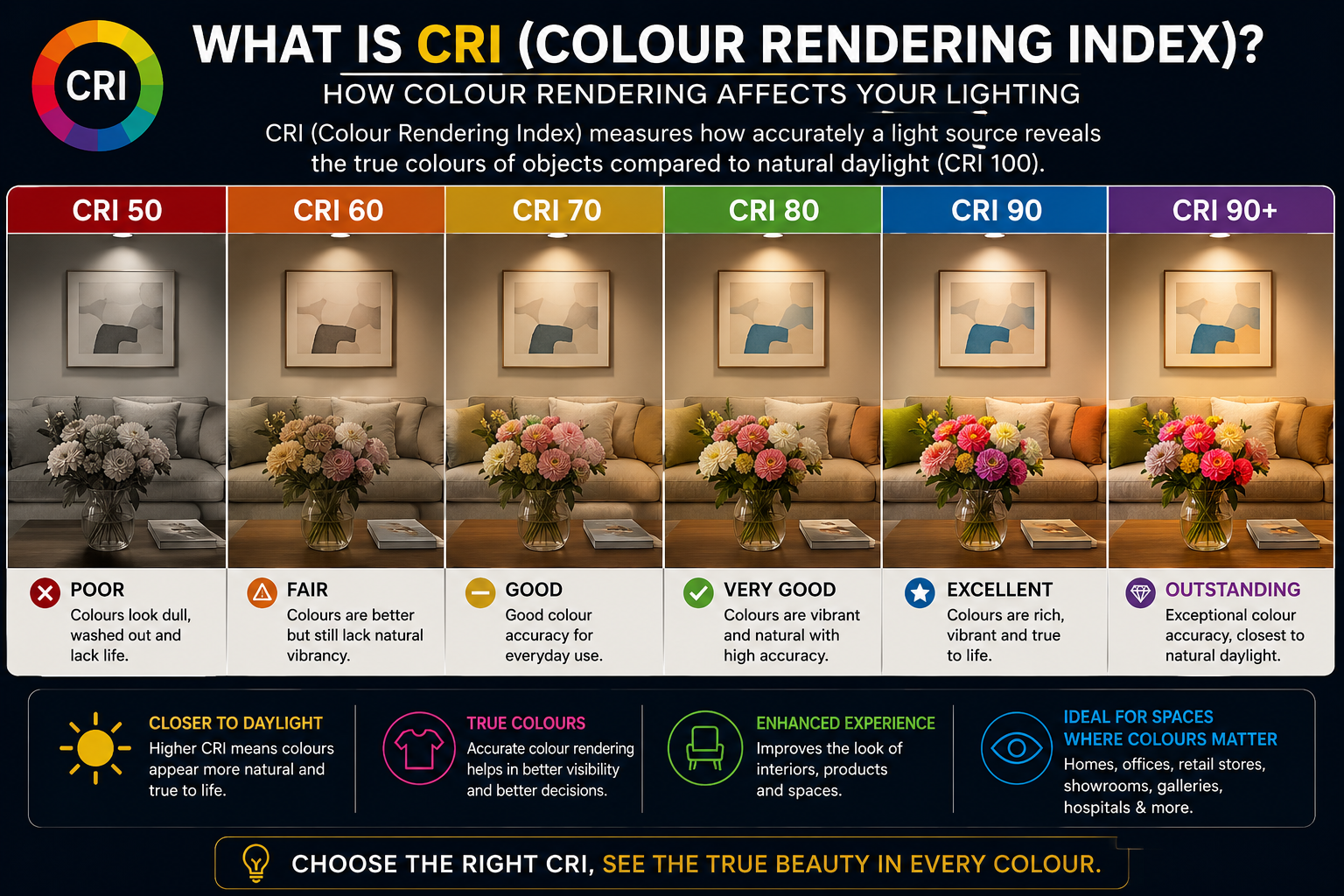
Colour Rendering Index, commonly known as CRI, is a measurement that tells us how accurately a light source reveals the true colours of objects compared to natural daylight.
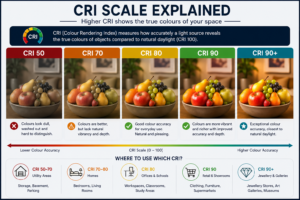
CRI is measured on a scale from 0 to 100.
The closer the CRI value is to 100, the more natural and accurate colours appear.
Think of natural daylight as the benchmark. During the daytime, colours usually appear vibrant and true to life because sunlight has an excellent ability to reveal different shades. Artificial lighting is measured against this standard.
For example, imagine placing two red apples under two different LED lights.
Both lights may have the same brightness and even the same colour temperature, but if one has a CRI of 80 and the other has a CRI of 90, the apple under the higher CRI light will generally appear richer, more vibrant, and closer to its natural colour.
This is why CRI is an important consideration in spaces where colour accuracy matters, such as homes, clothing stores, art galleries, salons, hospitals, and retail showrooms.
Why Should You Care About CRI?
Many people assume that a brighter light automatically provides better visibility. In reality, brightness and colour accuracy are two different things.
A high-quality LED light should not only provide sufficient brightness but also allow you to see colours clearly and naturally.
Choosing the right CRI can help you:
- Make furniture, wall paint, flooring, and decor look closer to their actual colours.
- Improve the appearance of clothing, jewellery, artwork, and retail displays.
- Create a more comfortable visual experience in homes and workplaces.
- Help customers make better purchasing decisions in showrooms and retail stores where colour accuracy influences buying choices.
- Support architects and interior designers in presenting materials and finishes as they were intended to look.
For this reason, CRI is often considered one of the most important specifications when selecting lighting for premium residential and commercial spaces.
Frequently Asked Questions (FAQs) About CRI in Lighting
Does a Higher CRI Make a Light Brighter?
No. CRI and brightness are two different things. Brightness is measured in lumens, while CRI measures how accurately colours appear under a light source. A higher CRI improves colour accuracy, not brightness.
Is CRI 80 Good Enough for Home Lighting?
Yes, CRI 80 is suitable for most homes and everyday use. However, if you want colours to look more natural and vibrant—especially in living rooms, kitchens, or areas with premium interiors—a higher CRI may provide a better visual experience.
Should I Choose CRI 90 Instead of CRI 80?
It depends on the application. CRI 90 is a great choice for places where colour accuracy matters, such as showrooms, salons, art galleries, and premium residential spaces. For general lighting, CRI 80 is usually sufficient.
Does CRI Affect Electricity Consumption?
No. CRI does not determine how much electricity a light uses. Power consumption depends on the wattage and efficiency of the LED, not its Colour Rendering Index.
Why Do Architects and Interior Designers Consider CRI Important?
Architects and interior designers use CRI to ensure that paint colours, furniture, fabrics, flooring, and decorative finishes appear as intended. A suitable CRI helps maintain the true appearance of materials and creates a more visually pleasing space.
Which CRI is Best for Homes?
For most homes, a CRI of 80 or above works well. If you want better colour accuracy in areas like the kitchen, living room, or dressing area, choosing a higher CRI can enhance the overall appearance of the space.
Does CRI Affect Eye Comfort?
Not directly. Eye comfort depends on several factors, including brightness, glare, colour temperature, and the quality of the lighting design. While CRI improves how accurately colours appear, it is not the primary factor that determines visual comfort.