









Not every LED light is designed for the same environment.
A light that performs perfectly in a living room may not be suitable for a bathroom, balcony, garden, or outdoor pathway. That’s because different spaces expose lighting fixtures to varying levels of dust, moisture, and weather conditions.
This is where IP Rating (Ingress Protection Rating) becomes important. It helps you understand how well an LED light is protected against dust and water, making it easier to choose the right fixture for both indoor and outdoor applications.
Whether you’re an architect planning a commercial project, an interior designer selecting decorative lighting, or a homeowner renovating your space, understanding IP ratings can help you choose lighting that is both safe and long-lasting.
In this guide, we’ll explain what an IP rating is, what the numbers mean, and how to choose the right IP rating for different spaces.
What is an IP Rating?
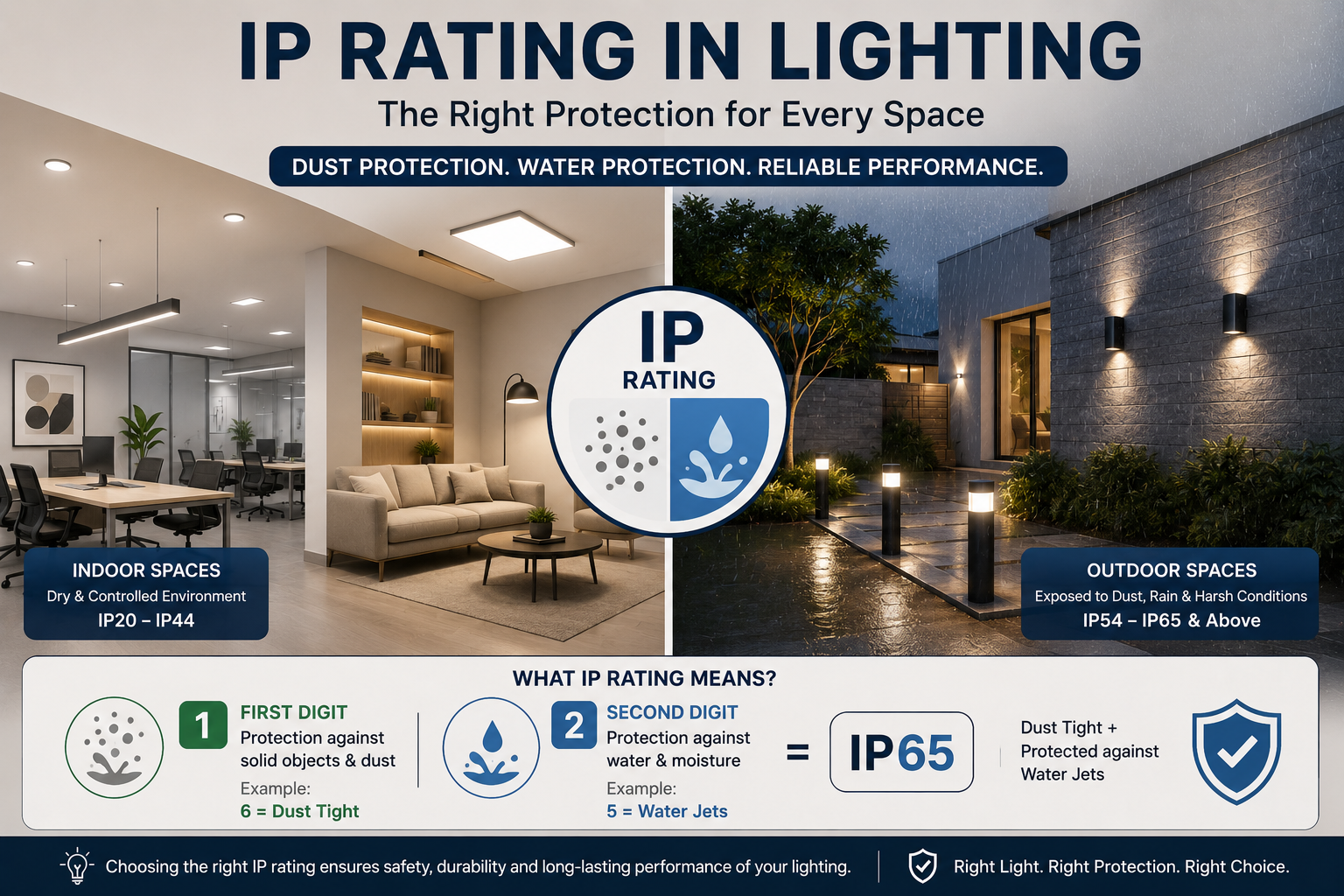
IP Rating, short for Ingress Protection Rating, is an international standard that indicates how well an electrical product is protected against the entry of solid particles (such as dust) and water.
Every IP rating consists of two numbers.
For example:
IP65
- First Digit = Protection against dust and solid objects
- Second Digit = Protection against water
The higher the number, the greater the level of protection.
Understanding the Two Digits in an IP Rating
-
First Digit – Dust Protection
The first number tells you how well the fixture is protected against solid objects and dust.
| First Digit | Protection Level |
|---|---|
| 0 | No protection |
| 2 | Protected against fingers or large objects |
| 4 | Protected against small tools and wires |
| 5 | Dust protected (limited dust may enter without affecting performance) |
| 6 | Completely dust-tight |
For most indoor and outdoor LED lighting, you’ll commonly see IP5X or IP6X ratings.
-
Second Digit – Water Protection
The second number indicates the level of protection against water.
| Second Digit | Protection Level |
|---|---|
| 0 | No protection |
| 4 | Protection against water splashes |
| 5 | Protection against low-pressure water jets |
| 6 | Protection against powerful water jets |
| 7 | Protection during temporary immersion in water |
| 8 | Protection during continuous immersion (under specified conditions) |
For outdoor lighting, IP65 is one of the most widely used ratings because it provides reliable protection against both dust and rain.
Common IP Ratings Used in LED Lighting
Not every project requires the highest IP rating. The ideal choice depends on where the light will be installed. (Ip Rating Chart For Led Lights)
| IP Rating | Best Suited For |
|---|---|
| IP20 | Living rooms, bedrooms, offices, showrooms |
| IP44 | Bathrooms, kitchens, utility rooms |
| IP54 | Covered balconies, parking areas, commercial entrances |
| IP65 | Outdoor walls, gardens, pathways, building exteriors |
| IP67 | Underground lighting and areas exposed to temporary water immersion |
IP20 vs IP44 vs IP65
Understanding the differences between the most common IP ratings can make product selection much easier.
| Feature | IP20 | IP44 | IP65 |
|---|---|---|---|
| Dust Protection | Basic | Basic | Dust-tight |
| Water Protection | None | Water splashes | Water jets and rain |
| Indoor Use | ✔ | ✔ | ✔ |
| Outdoor Use | ✘ | Limited | ✔ |
| Bathrooms | ✘ | ✔ | ✔ |
| Gardens & Pathways | ✘ | ✘ | ✔ |
If you’re unsure whether a fixture will be exposed to moisture, it’s generally safer to choose a higher IP rating.
Does a Higher IP Rating Always Mean Better?
Not necessarily. A higher IP rating provides greater protection against dust and water, but that doesn’t mean every indoor light should be IP65.
For example:
- An IP20 LED panel light is perfectly suitable for most offices and living rooms.
- An IP65 flood light is designed to withstand outdoor weather conditions, making it a better choice for gardens, parking areas, and building exteriors.
Choosing the right IP rating for the environment is more important than simply choosing the highest one.
Choosing the Right Lighting Along with the Right IP Rating
IP rating is only one part of selecting the right LED lighting. For the best results, it’s also worth considering:
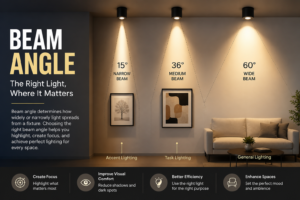
- Beam Angle to control how light is distributed across the space.
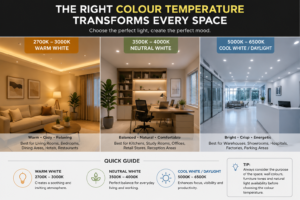
- Colour Temperature to create the right ambience.
- CRI (Colour Rendering Index) for accurate colour appearance.
- UGR (Unified Glare Rating) to improve visual comfort in workspaces.
Together, these factors help create lighting that is safe, efficient, and comfortable.
Recommended LED Products Based on IP Rating
Different lighting applications require different levels of protection.
For example:
- IP65 COB Lights are ideal for bathrooms, balconies, and outdoor soffits where moisture resistance is important, where as cob with IP20 are ideal for indoor use
- LED Flood Lights are commonly used for parking areas, building facades, warehouses, and security lighting and are required to have an IP65 rating
- Bollard Lights, Garden Lights, and Gate Lights typically benefit from IP65 protection to withstand rain and dust.
- Wall Washer Lights installed on exterior walls should also have an appropriate IP rating for reliable outdoor performance.
Choosing the right product with the appropriate IP rating helps improve durability and reduces long-term maintenance.
Common Mistakes to Avoid
When selecting LED lighting, avoid these common mistakes:
- Using IP20 fixtures in bathrooms or outdoor spaces.
- Assuming every outdoor light has the same level of protection.
- Choosing products based only on appearance without checking the IP rating.
- Believing that a higher IP rating is always necessary for indoor applications.
- Ignoring the environmental conditions where the fixture will be installed.
Frequently Asked Questions
1. What do the two numbers in an IP rating mean?
The first number indicates protection against dust and solid objects, while the second number indicates protection against water.
2. Is IP65 waterproof?
IP65 is protected against dust and low-pressure water jets, making it suitable for outdoor use and rainy conditions. However, it is not designed for continuous underwater immersion.
3. Is IP44 suitable for bathrooms?
Yes. IP44 is commonly used in bathrooms because it provides protection against water splashes. Areas that are directly exposed to water may require a higher IP rating, such as IP65.
4. Can I use an IP20 light outdoors?
No. IP20 fixtures are intended for dry indoor environments and should not be installed in areas exposed to rain or moisture.
5. Which IP rating is best for outdoor lighting?
For most outdoor applications such as gardens, pathways, building exteriors, and parking areas, IP65 is a reliable choice.
6. Does a higher IP rating increase the lifespan of a light?
A suitable IP rating helps protect the fixture from environmental damage, which can improve durability. However, overall lifespan also depends on factors such as build quality, LED driver performance, and installation.
7. Do indoor LED lights need an IP rating?
Yes. All LED lights have an IP rating, including those designed for indoor use. However, not every indoor space requires a high IP rating.